Summary: Avebury Walk Guide: Stone Circle Route + Tips
This walk around Avebury explores one of the most significant prehistoric landscapes in Britain, passing through the stone circles, ancient monuments, and surrounding countryside.
Distance: ~6-7km
Time: ~2-3 hours
Start: Avebury village / National Trust car park
Stone circles, burial chambers, and the equivalent of an ancient pyramid. You might think this describes an archaeological site in Egypt, but you’d be wrong. Instead, it lies deep in the English countryside.
Welcome to the Avebury World Heritage Site, one of the most fascinating and perhaps most understated historical landscapes in Europe. It’s a place where ancient history feels quietly alive, and where I spent a full day rambling today.
What is the Avebury World Heritage Site?
The Avebury World Heritage Site is an area around the village of Avebury known for its unusual density of Neolithic and Bronze Age monuments. Within the site is the world’s largest prehistoric stone circle, as well as the largest man-made prehistoric mound in Europe. It is a truly epic site and a location of scientific and historical importance (for more on Avebury see this book).
Where is Avebury and how do you get there?
Avebury is in Wiltshire, England, about 12 miles south of Swindon. For drivers, there is a pay-and-display car park, which is free for National Trust members. For non-drivers, a regular bus service runs between Swindon and Devizes via Avebury throughout the day. Alternatively, many people cycle or hike to the site from nearby towns and villages or via the Ridgeway National Trail (known as “Britain’s Oldest Road”), which runs from Overton Hill (near Avebury) to Ivinghoe Beacon in Buckinghamshire.
Reflections on Avebury
I planned my day in Avebury a little differently from most visitors. Rather than heading straight into the village, I began with a visit to Silbury Hill and West Kennet Long Barrow, both located roughly 1–3 miles away.
From the car park, you cross the road and almost immediately pick up a bridleway that leads towards these two monuments. The trail snakes through a striking chalk landscape, following the transparent waters of the River Kennet, “a rare chalk stream”. On an overcast and breezy day like this, the force of the wind across the open hills felt almost electric, turning the walk into one of those moments that makes you pause and reflect on the raw power of nature.
Silbury Hill – a prehistoric mystery in plain sight

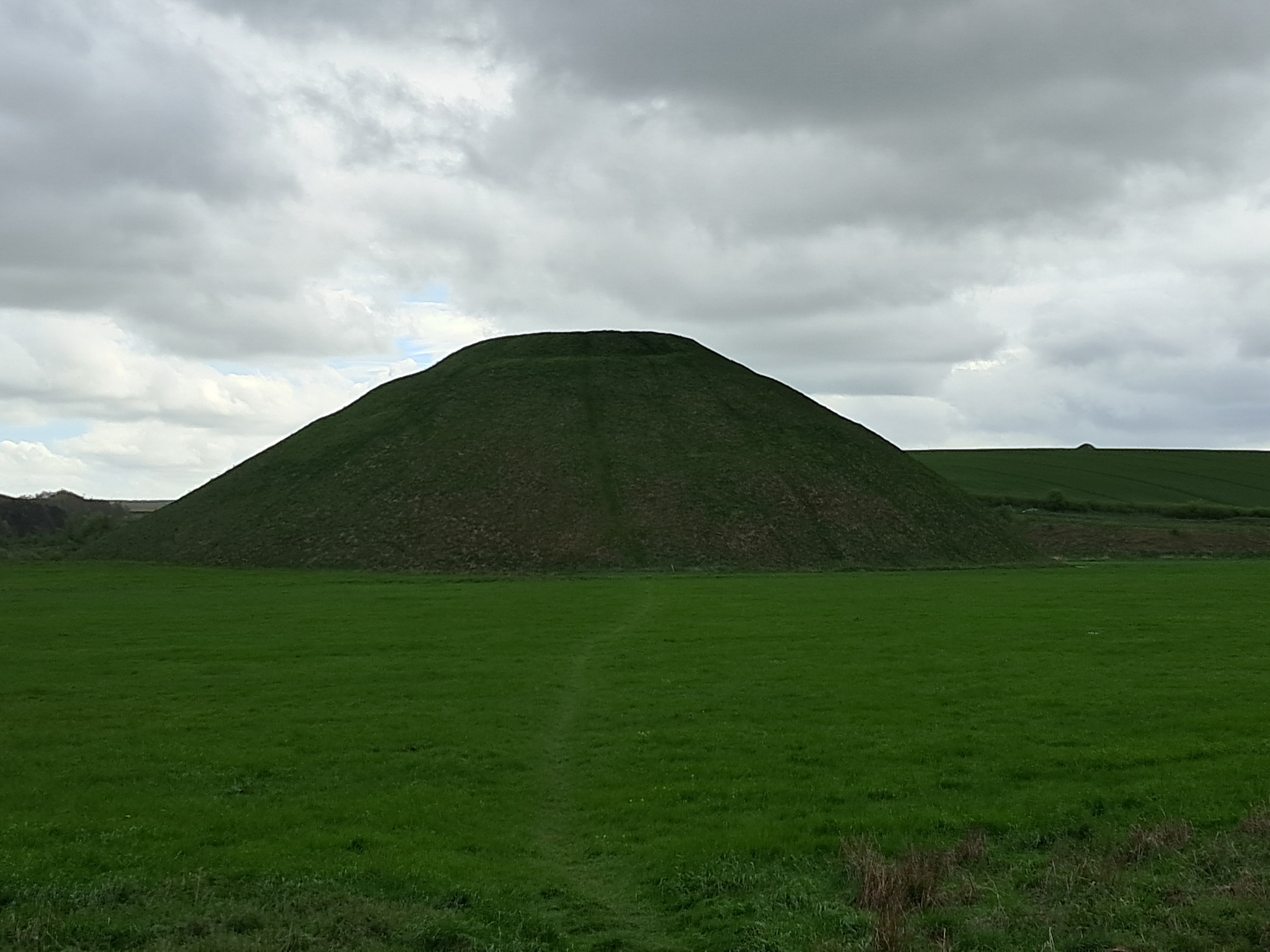
After twenty or thirty minutes of walking, you come across what appears to be a strange, pyramid-shaped hill rising above the landscape. This is Silbury Hill, arguably just as enigmatic as more famous ancient monuments such as the Egyptian pyramids or Stonehenge.
Built between around 2470 and 2350 BC, it is the largest prehistoric man-made mound in Europe, standing approximately 30 metres high. Constructed from chalk and clay gathered from the surrounding area, it would once have gleamed bright white, a striking contrast against the greens and blues of the landscape.
Walking past the structure, it’s hard not to reflect on the people who built it some 4,000 years ago, their ingenuity all the more remarkable given the rudimentary tools at their disposal: deer antler picks, cattle shoulder blades used as shovels, and woven baskets for transporting material. It raises an interesting question: could we construct such a monument today within the same timeframe, given modern planning regulations and layers of bureaucracy?
Perhaps the most compelling aspect of Silbury Hill is that its purpose remains unknown. Despite excavations, no burials or internal chambers have been found, leading many to suggest that it may have served a ritual or ceremonial function (see this book for more on Silbury Hill).
West Kennet Long Barrow — a sombre presence on the ridge

If you continue along the trail for another 20–30 minutes, you come across a less imposing but equally impressive structure. This structure is called West Kennet Long Barrow, an extremely well-preserved Neolithic chambered tomb whose interior is accessible to the public. Built around 3650 BC, it once held around forty-six individuals, along with pottery, beads, and tools.
On arrival, you are greeted by a forecourt fronted by imposing sarsen stones. Passing through them, you are met by a long passageway leading into a series of chambers. This passageway extends some 12 metres into the structure, giving it a somewhat haunting atmosphere, especially without a torch and with the wind howling along the ridge on which the barrow sits.
Despite this, the site is deeply impressive, and the centuries of ceremonial activity here create a powerful sense of presence, not unlike the feeling of entering a great medieval cathedral.
Avebury — a circle without walls, open to sky and time
After walking four miles to and from West Kennet Long Barrow, I was ready for a bit of relaxation. I decided to head into Avebury and experience its stone circle.

Up to this point, I had encountered only a handful of people, but Avebury was noticeably busier, with an eclectic mix of family groups, day trippers, historians, and modern-day druids. My first stop was the village centre, where you’ll find a 17th-century barn, a café, a Tudor manor house, and a small museum.
The museum itself was modest, but it contained some fascinating artefacts, including the skeleton of a child and tools engraved with intricate markings. I am always struck when I see engravings that are over 4,000 years old; it makes me question the nature of time itself, imagining someone long ago going about their daily life and leaving behind marks that still endure today. I start to question things like whether time is linear and even the nature of causation.
After exploring the museum, I took a stroll around the stone circle itself. Avebury Stone Circle is the largest prehistoric stone circle in Britain, a vast presence in the landscape. It consists of a great outer ring enclosing two smaller inner circles, all set within an impressive bank and ditch that traces its circumference. Constructed between 2850 BC and 2200 BC, it is widely believed to have served ceremonial or ritual purposes.

What makes Avebury even more special is the fact that nestled within the circle is the village of Avebury itself. This is a quaint settlement of thatched cottages and tiled houses gathered around St James’ Church. It is an unusual and striking juxtaposition of timelines, where the modern world meets the ancient, and the ancient, in turn, reaches back into the prehistoric.
Walking among the stones, you are free to move right up to them, to trace their rough surfaces and stand in their shadow. Unlike many historic sites, there are no barriers here, and that openness makes the experience feel more immediate, more personal. Children run between the stones, dogs weave through them, and visitors pause quietly, each engaging with the place in their own way.
There is a calmness to Avebury, despite the number of people. The sheer scale of the circle seems to absorb sound and movement, leaving behind a sense of space. It is less dramatic than the ridge-top barrow, but no less powerful. Instead of awe tinged with unease, there is a quieter feeling here, where time seems to weave in different directions.
Recommendation
Avebury is both fascinating and deeply atmospheric. However, the area cannot be fully appreciated without also visiting the lesser-known sites of Silbury Hill and West Kennet Long Barrow.
Given the skill and resources required to build these structures, along with their size and sheer number, Avebury stands as one of the great prehistoric wonders of the world, comparable to sites in Egypt, the Middle East, and the Mediterranean.
I hope this post gave you some inspiration. If you enjoyed this post you might also enjoy the post on Waddesdon (see post)
If you’ve enjoyed reading,
you can support the site with a coffee, helps keep the walks going. buymeacoffee.com/walkcuriously. Some of the links on this page are affiliate links, which means I may earn a commission if you make a purchase through them. As an Amazon Associate, I earn from qualifying purchases. This helps support the site at no extra cost to you.
Things to do in Avebury
- West Kennet Long Barrow
- Silbury Hill
- Avebury Henge and Stone Circle
- Avebury Manor
- Alexander Keiller Museum