Worcester sits quietly between the limestone villages of the Cotswolds and the industrial pulse of Birmingham. It’s the kind of place where history doesn’t just sit in museums, it seeps into the streets, the riverbanks, and the stonework of its buildings.
The walk into Worcester city centre
I parked at a Sainsbury’s on Windermere Drive, about three miles from the city centre, and walked in via Blackpole Road and Rainbow Hill.
The route took me through 20th-century council estates and rows of Victorian terraces before gradually merging into the city itself, a physical reminder of how Worcester has expanded over time.
Worcester is not one of those traditional chocolate-box locations. Some of the streets showed the same contrasts you see in many towns and cities across the UK today with homeless and urban poor jostled alongside independent shops and a vibrant multicultural community. A few areas felt a little rough around the edges, but at no point did I feel unsafe.
Shops, shops and more shops…
The first thing you reach is the central shopping area. Compared to other towns and cities of a similar size, Worcester feels lively and well-served, with several shopping centres, including Cathedral Square and Friary Walk.
Tucked among the modern shops is Greyfriars House and Garden, a timber-framed medieval building dating from around 1480. It was built for Thomas Grene, a local brewer, and offers a glimpse into late medieval merchant life.
Worcester Cathedral
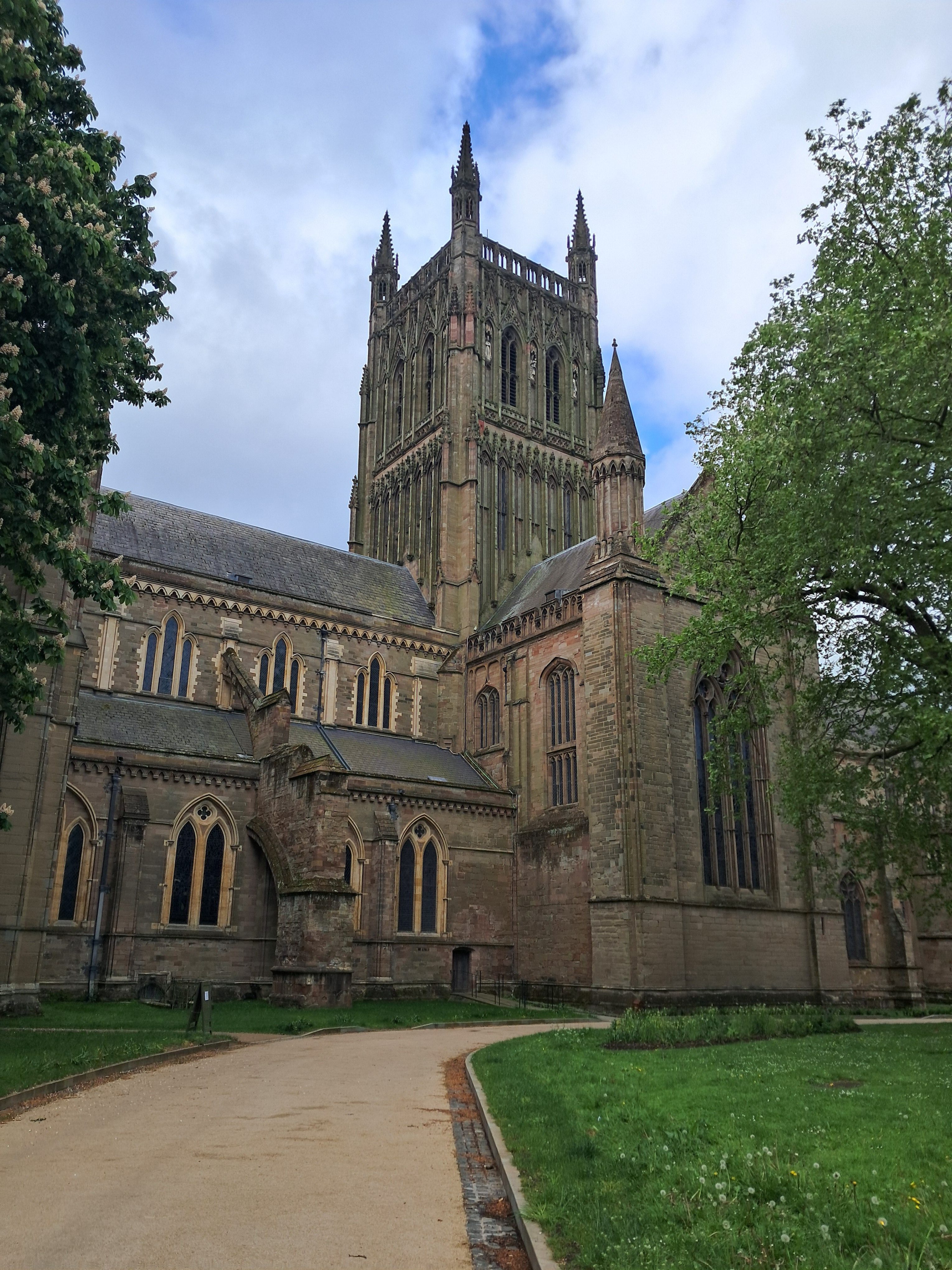
As you move through the shopping districts, Worcester Cathedral gradually comes into view, its tower rising above the River Severn. From the outside, it looks like a church from the industrial revolution, but this is clearly not the case when you enter through its doors.
The space opens into the nave, where the ceiling stretches high overhead, drawing your eyes upwards almost instinctively. It is hard not to pause here. There’s a stillness to the place, despite its long and often turbulent history.

That history runs deep. The cathedral’s origins date back to 680, with a later foundation established by Saint Oswald in 983. The building you see today began under Saint Wulfstan in 1084, the last Anglo-Saxon bishop of England. Both men were buried here, although their tombs were lost during the upheaval of the Reformation.
Walking further inside, the layers of time become more obvious. Norman architecture gives way to later medieval additions and, eventually, to Victorian restorations. It feels less like a single building and more like a timeline you can walk through.
The organ comes into view next, modern but framed within a historic 19th-century case. Built by Kenneth Tickell in 2008, it bridges past and present in a way that feels very fitting.
Beyond that lies the quire, dating from the early 13th century. Look up, and the ceiling is alive with Victorian paintings, unexpectedly vibrant, almost theatrical. It’s one of those details that catches you off guard.

The cathedral has not always been so serene. During the English Civil War, it suffered significant damage and fell into disrepair. The extensive Victorian restoration that followed reshaped much of what you see today. Traces of that conflict remain, most notably in the tomb of James Hamilton, Duke of Hamilton.
Then there’s the crypt.
Stepping down into the 11th-century Norman crypt feels like entering another world. The air is cooler, the light softer. Here, the cathedral’s story becomes more personal. Among the exhibits is the grave of the “Worcester Pilgrim,” discovered beneath the cathedral floor in 1987. Thought to be Robert Sutton, a local dyer and bailiff, he was buried in the 15th century, still wearing his knee-high leather boots, which are now displayed in the crypt. It’s a small detail, but one that makes the past feel suddenly real.
Back above ground, the cathedral library quietly preserves the intellectual life of its former Benedictine community. Among its treasures are works linked to Bede, whose influence on early English history and learning is hard to overstate.
The Cloisters – a less formal retreat
Eventually, I made my way into the cloisters. Enclosed on all sides, they form a peaceful square around a small cemetery garden. The stonework is delicate, full of repeating patterns and carvings that reward a slower pace. Somewhere nearby, faint choral music echoed through the space, blending with the rustle of leaves. It’s the kind of place that invites you to stop and simply contemplate.
The Chapter House, which sits just off the cloisters, leaves a different impression. Built in the 12th century and thought to be one of the earliest circular chapter houses in England, it feels unusual from the moment you step inside. The shape changes the way sound and light move through the room. It isn’t the most ornate part of the cathedral, but it might be the most memorable.
The flowing River Severn
When I finally stepped back outside, the river was waiting.
The River Severn curves gently past the cathedral, with paths stretching in both directions. The Wulfstan Way begins nearby, heading towards the distant outline of the Malvern Hills. It was tempting to follow it, but my 40 years of life experience is beginning to teach me that sometimes the better choice is simply to sit and do nothing at all.


The Commandery
Later, I made my way to The Commandery, a place where Worcester’s history feels a little less distant.
At first glance, it looks like a quiet historic building. But this was once the Royalist headquarters during the Battle of Worcester, one of the final clashes of the English Civil War.
Its story stretches back much further. The site began as the Hospital of St Wulfstan around 1085, before being rebuilt in the 15th century. Following the Dissolution of the Monasteries under Henry VIII in 1540, it passed into private hands, eventually belonging to the Wylde family, whose Royalist loyalties shaped its role in the war.
Standing there, it’s strange to think how many lives the building has lived: hospital, home, military headquarters, and more.
Just beside it runs the Worcester and Birmingham Canal. Today, it’s a far quieter scene, with towpaths leading towards Droitwich Spa and beyond. I ended up at the café overlooking the water, watching the boats and enjoying the sun (something we do not get much of in the United Kingdom).
Museum of Royal Worcester
I could not come to Worcester without acknowledging its porcelain-making past. Royal Worcester was established in 1751 and is one of the oldest porcelain brands in England.
The Museum of Royal Worcester explores this heritage and houses the largest collection of Royal Worcester porcelain in the world. I did not have time to go inside, but even walking around the site and stopping for a coffee, gave a sense of how important this industry once was to the city.
The journey ends…
After leaving the museum, I retraced my steps back to the Sainsbury’s car park.
Reflecting on the day, Worcester might not have the chocolate box postcard charm of places like Stratford or Oxford, but that’s part of its appeal. It feels layered and complex. A more typical representation of the United Kingdom.
On the way back, I could not resist a detour to Gorse Hill and Elbury Mount Local Nature Reserve. The temptation to take in a panoramic view of the surrounding countryside was too much. Worcester sits between the Cotswolds, the Malvern Hills, and the Shropshire Hills, and the landscape reflects that, varied, understated, and quietly impressive. It felt like a fitting way to end the day.
