The Chilterns are often overlooked in favour of better-known countryside destinations such as the Cotswolds or the South Downs. Personally, I think that’s a mistake. In many ways, the Chilterns feel more varied, more peaceful and just as beautiful as their more famous neighbours.
Princes Risborough – A royal market town
I decided to head out for a longer walk and started in the quiet market town of Princes Risborough, which sits beneath a striking white chalk cross cut into the escarpment above the town. The cross has watched over Risborough for centuries, although nobody seems entirely certain where it came from. Like many old landmarks, its origins are tangled up in local folklore and legend.

Princes Risborough was originally known simply as Risborough. The “Princes” prefix seems to have appeared during the 15th century and probably refers to Edward the Black Prince, who held the manor here in the 14th century. The town remained a royal manor until Charles I sold it in 1628.
Leaving the town behind, the suburban edges quickly give way to sports fields and then open farmland. Before long, the route begins climbing steadily into the woods around Brush Hill.
The Chilterns – a varied landscape
In previous posts I’ve written about chalk landscapes such as Avebury and Uffington. What makes the Chilterns different is the sheer variety of the scenery. Instead of endless open downs, the landscape constantly changes. One moment you are walking through woodland, the next across meadows or farmland, before dropping into quiet villages hidden among the hills. It keeps the walk interesting from start to finish.
The climb itself is fairly steep, although steps have been added to make the ascent easier. Thankfully, the woodland also provides plenty of shelter from both the sun and the wind. Once you reach the top, the views open up across Princes Risborough and out into Buckinghamshire and Oxfordshire beyond. Red kites regularly glide along the ridge, riding the thermals rising from the escarpment.

Like many ancient sites in southern England, the ridge also contains Iron Age burial mounds overlooking the downs below, a reminder that people have been drawn to these hills for thousands of years.

Further along the route, the landscape changes again as the path drops into another woodland. This one feels noticeably different. While the earlier woods are dominated by beech, oak and silver birch, here there are far more yew and Scots pine trees, giving the area a darker, almost upland feel.
Continuing eastwards, the woods eventually open onto ancient flower-rich grassland, an area well known for its orchids and butterflies. Species such as the silver-spotted skipper, chalkhill blue and green hairstreak can all be found here during the summer months. It is hard to imagine now, but between the 1940s and early 1970s this peaceful hillside was used as a military training range by the British Army.
From royal towns to the country seat of Prime Ministers…
One of the most notable points along the walk is Chequers, the official country residence of British Prime Ministers since 1921. The estate was gifted to the nation by Sir Arthur Lee in 1917. By that point, prime ministers were no longer drawn exclusively from the aristocracy and landed classes, so the idea was to provide future leaders with a countryside retreat where they could rest and work away from London.

Part of the original trust deed summed up the thinking rather well,
“The periodic contact with the most typical rural life would create and preserve a just sense of proportion between the claims of town and country…”
The highest point in the Chilterns – Coombe Hill

After several hours of walking, I eventually reached Coombe Hill, one of the highest and best-known viewpoints in the Chilterns. From the top, the views stretch for miles across the Buckinghamshire countryside and into Oxfordshire.
Much of Coombe Hill once formed part of the Chequers Estate before being transferred to the National Trust during the 1920s. At the summit stands a striking monument dedicated to the 148 men from Buckinghamshire who lost their lives during the Second Boer War.
Little Kimble
For the return journey, I decided to take a different route beneath the escarpment. This section of the walk passes through the old villages of Ellesborough, Great Kimble and Little Kimble, places with histories stretching back well beyond the medieval period. The area is thought to have once played host to both a Roman villa and a motte-and-bailey castle.
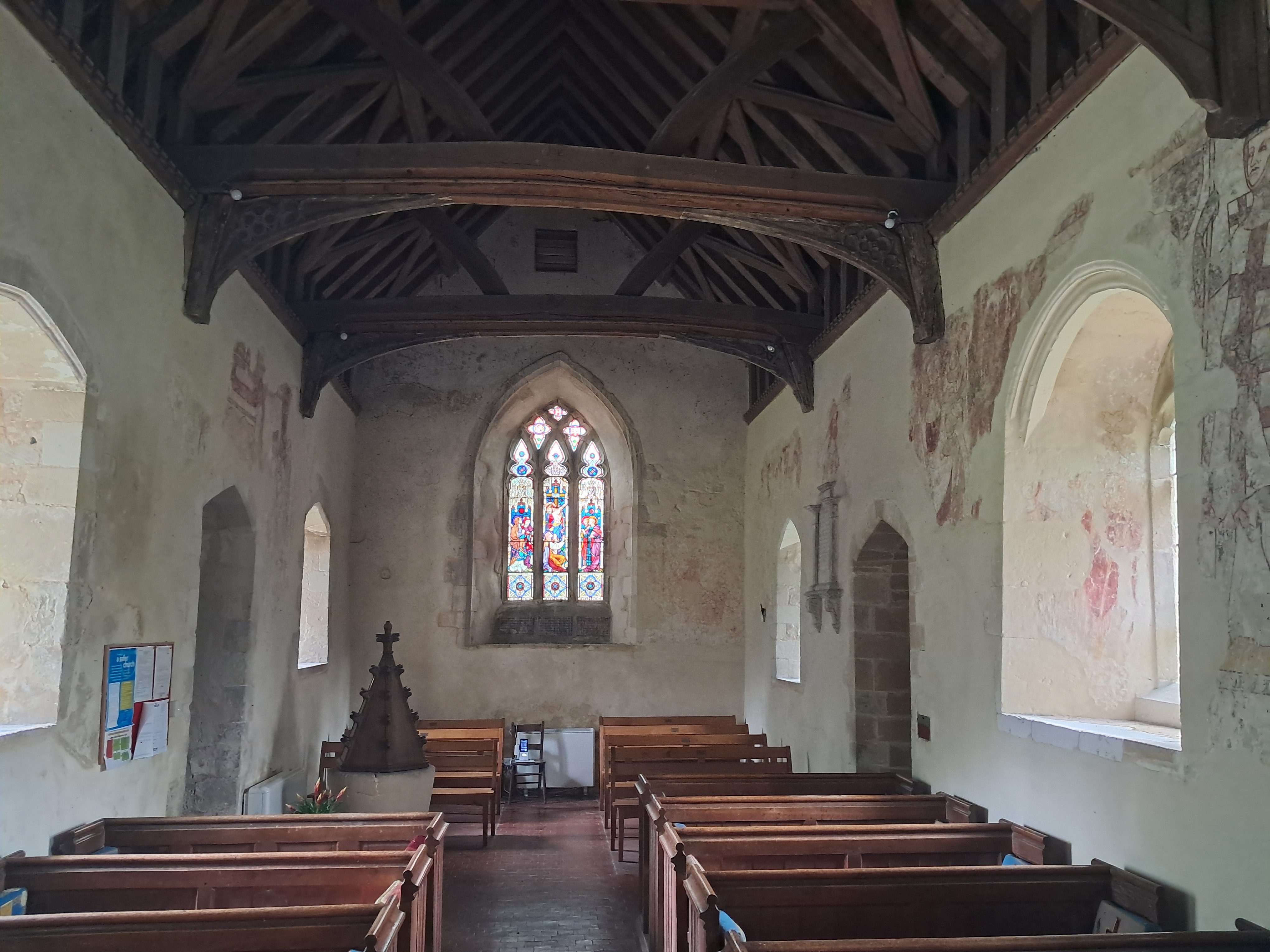
On the way, I stopped at All Saints Church in Little Kimble and could not resist having a look inside. It turned out to be one of the highlights of the day. The church dates back to the 13th century and still contains remarkably well-preserved 14th century wall paintings, along with a rare set of medieval tiles believed to tell the story of Tristan and Iseult.

Tristan and Iseult – a Medieval tale of forbidden love…
The story itself is one of the great medieval romances. Tristan, a knight and nephew of King Mark of Cornwall, travels to Ireland to escort the princess Iseult back to Cornwall so she can marry the king. During the journey, however, the pair accidentally drink a love potion and fall hopelessly in love with one another, setting off a tragic and forbidden romance.
By the time I reached Little Kimble, my legs were beginning to feel the distance, so I opted for the train back to Princes Risborough, a short journey of around ten minutes, and probably the sensible choice after a long day in the hills.