In a letter to her sister Cassandra Austen written in 1801, Jane Austen wrote the following about Bath:
“The first view of Bath in fine weather does not answer my expectations; I think I see more distinctly through rain. The sun was got behind everything, and the appearance of the place from the top of Kingsdown was all vapour, shadow, smoke, and confusion.”
This quote reflects Austen’s complicated relationship with Bath and suggests that our romantic expectations of places do not always match reality. My own impressions of Bath are similarly mixed. The city sits within a stunning landscape, full of elegant Georgian buildings and carefully planned squares. Yet that same grandeur can also make Bath feel slightly unreal, almost like a carefully constructed stage.
That being said, I thoroughly enjoyed my trip and think Bath is well worth visiting.
Roman Baths
Bath’s history and fame, did not start with the Georgian period. A temple was constructed in Bath between 60 and 70 AD, around which grew a small Roman settlement known as Aquae Sulis. The temple was built around the natural hot springs that were later used to create public baths.

These natural hot springs originate to the south of Bath in the Mendip range of limestone hills. Rainwater filters through the limestone before being heated deep underground through geothermal processes. The water then rises back to the surface through fissures and faults beneath the city, providing fresh water at “bath” temperature.
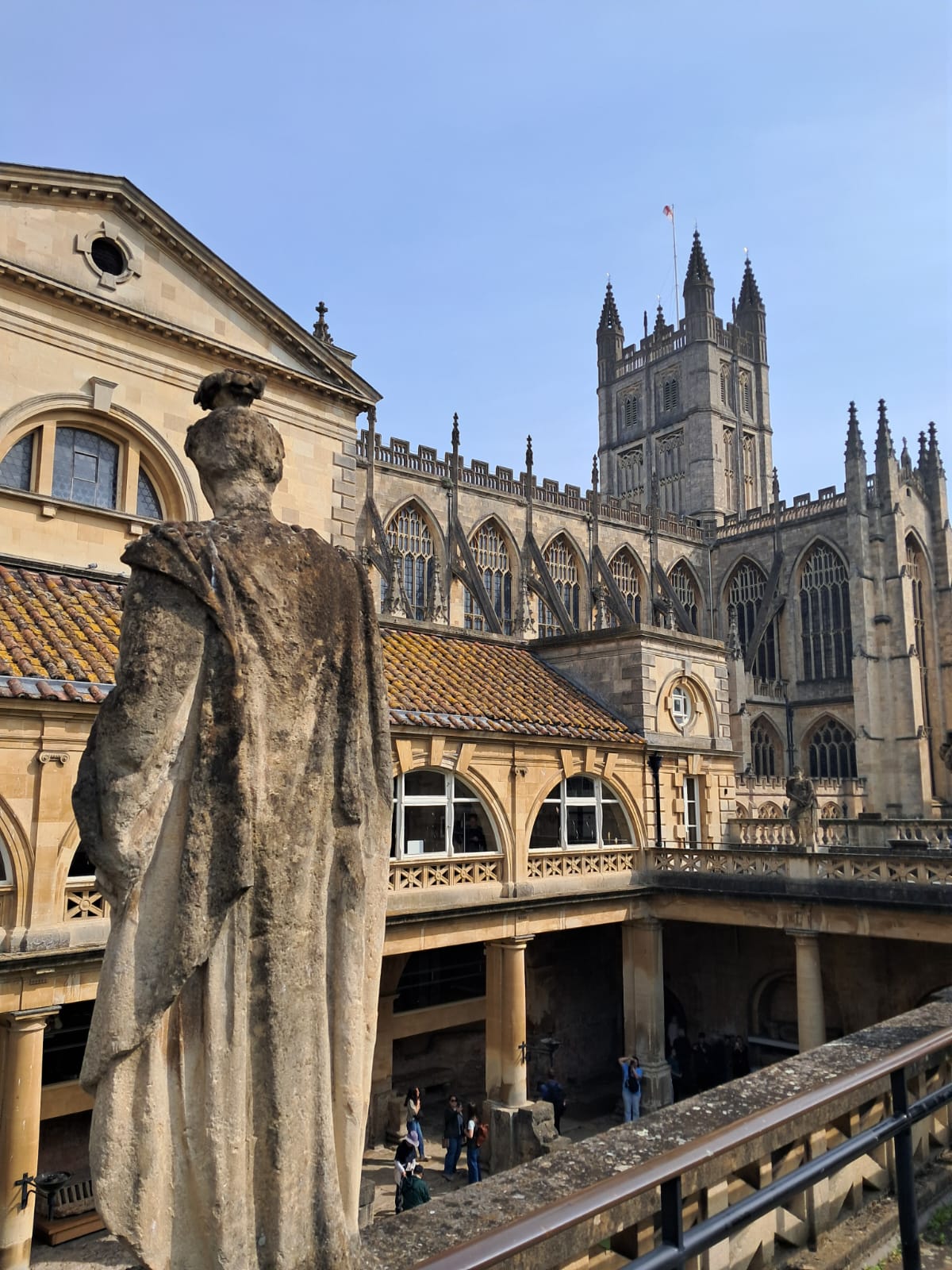
Today, the Roman Baths complex remains remarkably well preserved beneath the modern street level, and the museum allows visitors to explore these ancient remains in impressive detail. Walking through the baths, I was struck by how familiar parts of the complex felt, particularly the similarities to modern spas, saunas, and gyms. The site even included a Roman gymnasium. A reminder that although backdrops and technology may change, people remain people.

At the same time, the complex also highlights the stark differences between Roman society and the modern world, particularly the role of slavery and rigid social hierarchies. Even so, it is difficult not to see faint echoes of these forms of social and economic constraint in aspects of modern life.
The Abbey
Standing over the Roman Baths is the medieval Bath Abbey. The current Abbey was preceded by an earlier Saxon church. This Saxon church being famous as the location of the crowning of Edgar as King of all England in 973 AD. This history is recognised at the back of the building in stained-glass window dedicated to the coronation of King Edgar.
Accounts of Edgar’s reign are relatively scarce, but he was not afraid of controversy, particularly through his support for the Benedictine Reform, which saw secular clergy replaced by celibate monks.
Construction of the current Abbey began in 1499 after the earlier Norman cathedral had fallen into disrepair. The building itself later suffered further decline following Henry VIII’s dissolution of the monasteries before eventually being restored in 1620. Additional restorations and alterations took place during the industrial era and in modern times, resulting in the Abbey we see today.
Although the Abbey may not have been as architecturally striking as some of the other cathedrals and abbeys I have visited (see my post on Worcester), it is nonetheless a beautiful building. The white walls and ornate vaulted ceilings reminded me of modern portrayals of Minas Tirith from Tolkien’s works. Combined with the light pouring through the large leaded and stained-glass windows, the interior has an almost heavenly atmosphere.

The Canal and River
After visiting the Abbey, it felt like the perfect time to wander through the city and grab some lunch. Bath sits on both the River Avon and the Kennet and Avon Canal, and each waterway is lined with paths ideal for either a quiet stroll or a longer walk through the surrounding countryside.

One particularly appealing route runs from Bath to Bradford-on-Avon. At around eight miles, it makes for a substantial walk. I arrived in Bath too late in the day to attempt the full route. However, I did explore the opening stretch of the trail, and even this shorter section offered beautiful countryside views and fantastic vantage points back across the city.
Clevedon Pools
After walking back along the canal path, I decided to take a short detour to Clevedon Pools. I had brought my swimming kit with me, and with the weather being so warm, a swim seemed like an excellent idea. Unfortunately, to my disappointment, the pool was closed.
Clevedon Pools is a semi-circular lido dating back to 1815, making it one of the oldest surviving public outdoor swimming pools in the United Kingdom. The baths remained open until the 1970s before falling into disrepair. Following a major restoration project, the site reopened in September 2022. However, flooding has since caused extensive damage, forcing the site to close once again.
Regency Bath
After seeing Bath from the canal path, I wanted to gain a higher view of the city itself. During the Georgian era, several grand crescents were built as Bath became an increasingly fashionable retreat for the upper classes, the most famous of these being the Royal Crescent.

Before heading there, though, I decided to firstly visit Camden Crescent because of its elevated position overlooking the city. Built in 1788, Camden Crescent commands fantastic views across Bath and the surrounding hills. It has also appeared in several literary works, including Persuasion, where the Elliot family rent lodgings in the crescent. Camden Crescent is also the location of the sad murder of 6 year old Brenda Goddard by the serial killer John Thomas Straffen in July 1951.
I could not visit Bath’s crescents without stopping by the Royal Crescent itself. Built between 1767 and 1775, it is widely regarded as one of the finest examples of Georgian architecture and urban planning in the United Kingdom.
The crescent was designed to create the impression of a single grand country house within the city, an illusion that has largely been preserved thanks to Royal Victoria Park stretching out below it. The park itself was opened by Princess Victoria before she became queen and includes both the Bath Botanic Gardens and the Great Dell Aerial Walkway, a secluded wooded glade at the edge of the park.

The first house constructed on the crescent, No. 1 Royal Crescent, is now a museum designed to show how wealthy Georgians would have lived during the period. It offers a fascinating glimpse into Georgian upper-class life and how British society has evolved since then.
Jane Austen
Finally, this brings me back to Jane Austen.
En route back towards the Abbey and the Parade Gardens, I passed the Jane Austen Centre. The museum explores Austen’s life, works, and the wider world of Regency England.
Jane Austen lived in Bath from 1801 to 1806. Although she did not publish extensively during this period, there is little doubt that her time in the city influenced her later writing. Bath’s role as a fashionable Regency-era spa town for the wealthy provided the perfect backdrop for many of the themes Austen explored in her novels, particularly social pressure, status, reputation, and performance.
This can perhaps be seen most clearly in Northanger Abbey, where Catherine Morland experiences both the excitement and superficiality of Bath society firsthand.
Reflections
Bath’s crescents, elegant terraces, and carefully planned spaces create an atmosphere that can feel both enchanting and slightly artificial. Perhaps that is why Austen remains so closely associated with the city. Like her novels, Bath presents refinement and charm on the surface while quietly revealing social tensions and dark themes underneath.
Despite my mixed feelings, I left understanding why the city continues to inspire so many visitors, writers, and historians alike. As outlined earlier, this City is worth a visit.